
Begin a Bath County Property Records Search
Start with the Bath County Property Valuation Administrator when your clue is a street address. Its qPublic portal hosts the parcel search. A result card shows the parcel key you need. That key opens the Clerk's land records, the Sheriff's current-tax records, and the county map. Some fields may not appear for every parcel. Confirm what the portal displays rather than assuming. Keep your facts separate as you go. Owner spelling, situs address, mailing address, parcel identifier, legal description, and book/page references each answer different questions. A mailing address does not prove where an owner lives, and a map line is not a surveyed boundary.
- Search qPublic by the complete address, including the road name and postal place.
- Copy the parcel number, owner display, legal description, and value year.
- Ask the County Clerk for the recorded deed and related mortgages, liens, releases, or plats.
- Check current tax status with the Sheriff and delinquent filings with the Clerk.
- Use the parcel map as a locator, then obtain a survey or certified record when the issue requires proof.
Three Offices Behind Bath County Property Records
No single counter holds the full property trail. The Clerk records deeds and other land instruments. The PVA keeps assessment records, the Sheriff collects current real-estate tax, and delinquent bills move into the Clerk's lien-book process. For a parcel search, the official Bath PVA information site is the county's entry point.
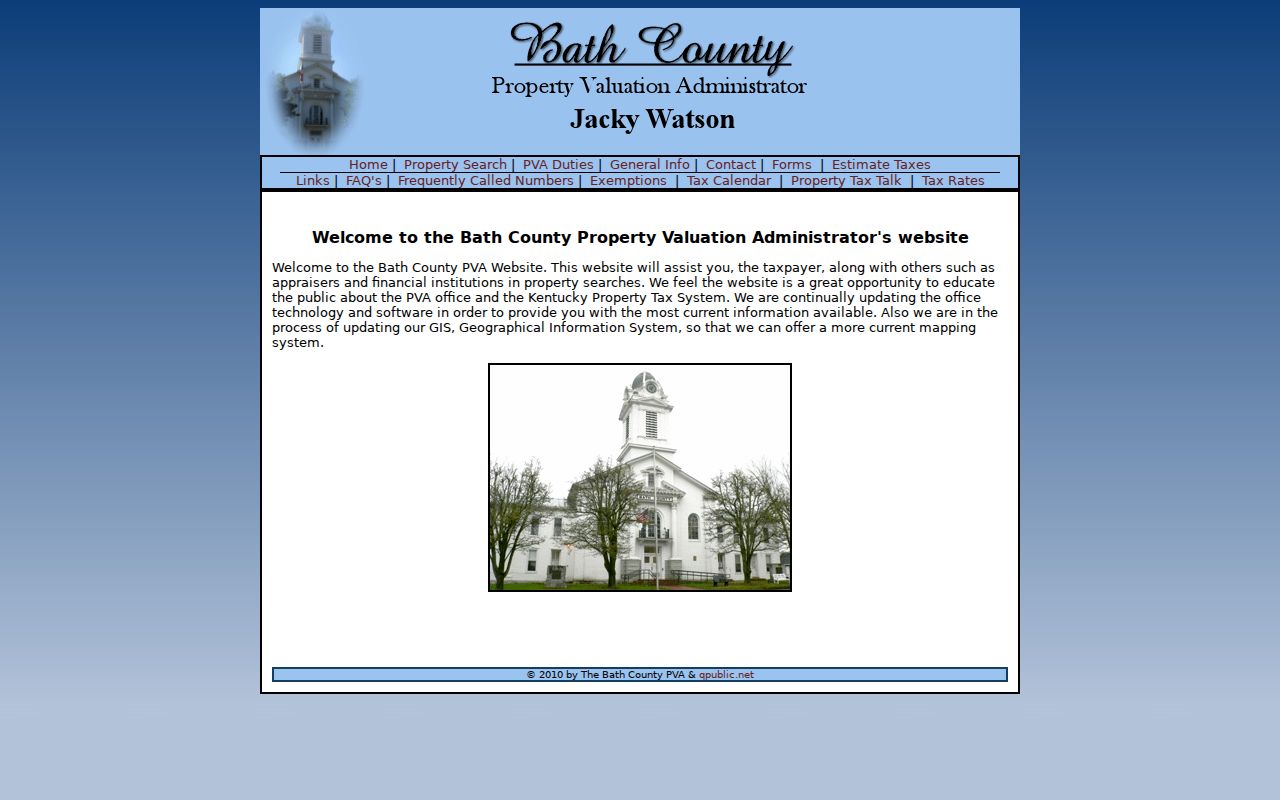
The PVA's own site lays out the parcel-search route. It confirms where the county's assessment records live without promising that every parcel card is online.
Address First, Parcel Number Next in Bath County
An address is easy to recognize. The parcel number is the stronger link. It ties assessment, map, tax, and deed research to one piece of land. Rural roads may carry a postal town outside municipal limits: Owingsville, Sharpsburg, and Salt Lick are incorporated, while Preston, Olympia, Midland, and Bethel often appear as community or mailing clues.
Parcel number: the PVA's identifier for an assessment parcel. Copy the number exactly as shown in a live result rather than adding a county-code prefix.
Old identifiers still matter. After a split, consolidation, or replat, a superseded parcel number can reconnect an earlier deed or tax entry to today's card.
Bath County Property Records by Question
Let the question pick the record. Assessment data gives a present snapshot, a deed supplies conveyance language, and a plat supplies recorded lot geometry.
| Record Type | What It Documents | Kept By | Access |
|---|---|---|---|
| Deeds | Transfers, parties, consideration, legal description | County Clerk | Office or written request |
| Mortgages and liens | Recorded claims and releases | County Clerk | Office or written request |
| Assessment | Owner display, value, exemptions, parcel data | PVA | qPublic, phone, email, counter |
| Current and delinquent tax | Bill status and filed delinquency | Sheriff, then Clerk | Office confirmation |
| Plats and parcels | Lot, road, acreage, and map context | Clerk and PVA | Recorded plat and GIS |
For the recorded transfer, use Bath County deed records. Valuation and billing questions belong to the assessment and tax sources, and no one source substitutes for the rest.
The January 1 Bath County Tax Snapshot
Kentucky assessment and property-tax records follow January 1 ownership. A mid-year sale does not change that. The tax record may still name the January 1 owner even after a newer deed is recorded. Contracts can split a bill between buyer and seller. They cannot rewrite the statutory snapshot. The Kentucky property tax calendar places listing early in the year and the PVA inspection and conference period in May. Note: Always compare the tax year with the recording date before treating two different owner names as an error.
When Bath County Transfers Reach the PVA
A historic local report described a monthly handoff of transfers from the Clerk to the PVA. A staffing backlog delayed some qPublic updates. That report shows how lag can happen. It promises nothing about today's processing time. A newly recorded deed may outrun the assessment owner display. For a recent sale, compare the deed date, recording date, grantee, legal description, PVA year, and January 1 tax owner; the comparison beats any single name.
Bath County Open Records Channels
The Clerk's open-record instructions accept two formats. A Kentucky Attorney General form or a written request both qualify. Either way, identify the requester and the exact documents sought. Delivery options are broad. Bring it to 17 West Main Street, email roger.coyle@ky.gov, mail PO Box 609, or fax 606-674-9526. The office allows five business days to respond and requires advance payment for copies. Ask separately about inspection, ordinary copies, and certification, because fees vary by service.
Bath County Deed Books Beyond the Web
Bath County publishes no public grantor-grantee web index. No online start year is listed either. FamilySearch catalog entries identify Bath deeds from 1811 through 1912, and KDLA explains how deed books and indexes can be searched on microfilm or by remote request. Catalog dates do not put every image online. The KDLA deed guide advises checking both grantor and grantee indexes. Before 1890, tax records may bridge deeds that lack a prior-record reference.
The Uncertain 1864 Bath County Records Gap
Kentucky's courthouse-disaster list places a Bath County event at about 1864. The entry names no lost series. It does not say whether deed, probate, court, tax, or marriage books were destroyed, so the date is not a blanket break in title history. Test any apparent gap yourself. Check surviving indexes, deed books, tax rolls, probate and order books, newspapers, KDLA microfilm, and FamilySearch images before giving up on a record. That series-by-series method protects real evidence from dismissal.
Limits of Bath County Property Records
Property records carry real weight, but they answer only certain questions. A deed record can confirm the owner of record. The assessor can list an appraisal. Yet Bath County records cannot prove every interest was ever recorded. They will not settle an adverse-possession claim either. Nor will they fix an exact boundary or forecast a sale price. One privacy shield does exist. Kentucky's Safe at Home program hides qualifying government and voter addresses. The state's own materials note that real-estate holdings stay outside that protection.
Lawful use. Bath County property records support due diligence, estate work, boundary research, and civic review. They may not be used to stalk, harass, or harm a person, and a record lookup does not replace a title examination or licensed survey.